The Decision at Hand
With FedRAMP Rev. 5 baselines now in play, cloud service providers must decide: invest in OSCAL-native tools or stick with the traditional Word-and-Excel approach that got you authorized initially. This isn't just theoretical. You're dealing with real budgets, timelines, and potential pitfalls if you choose poorly.
The shift from Rev. 4 to Rev. 5, based on NIST SP 800-53 Rev. 5, impacts every existing authorization in the FedRAMP marketplace. The question isn't whether to update but how. Some argue that OSCAL-native tools are the only viable path forward. Others see them as costly and unproven, solving problems most organizations don't face.
The Case for OSCAL-Native Tools
Traditionally, FedRAMP authorization relies on documents. Your System Security Plan is in Word, and control implementation statements fill Excel cells. Updates require manual edits, and evidence requests mean searching through folders. Every revision risks version control issues.
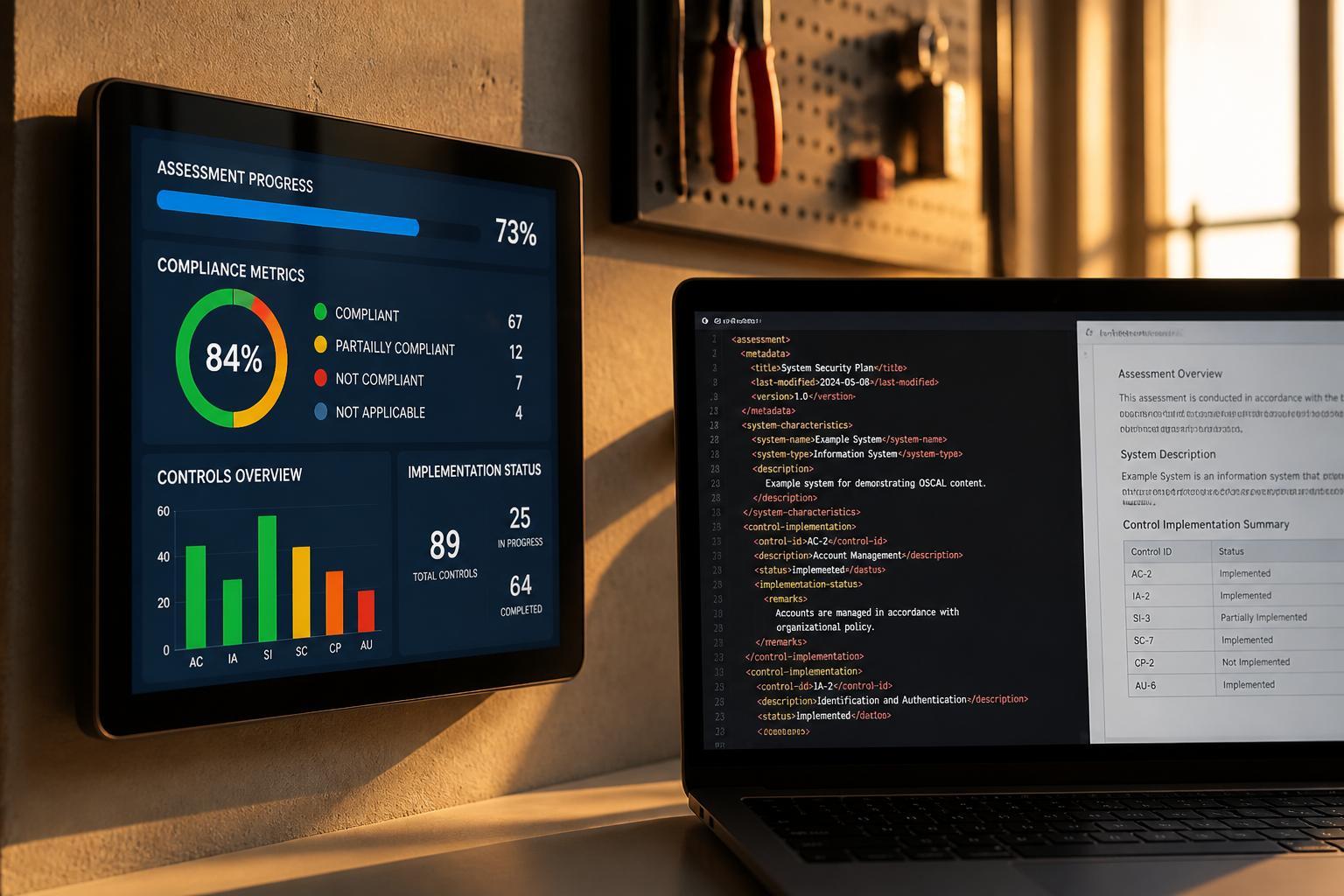
OSCAL-native tools offer a solution with machine-readable formats for control catalogs, baselines, system security plans, and assessment results. The Open Security Controls Assessment Language allows software to parse, validate, and update data automatically. Instead of manually tracking changes from Rev. 4 to Rev. 5, an OSCAL tool maps these changes and flags gaps.
Automation is a strong argument. When you change a security configuration, an OSCAL-native tool can update the control implementation statement and flag new evidence needs. Submitting packages in machine-readable format enables automated reviews, surfacing issues during development rather than costly authorization reviews.
Continuous monitoring is also crucial for maintaining an Authorization to Operate. You're describing a dynamic environment, not a static system. Manual documentation can't keep up. By the time you update your SSP for last quarter's changes, new modifications have already occurred. OSCAL-native tools update control implementations as your environment evolves.
Cost is another factor. FedRAMP certification is expensive, especially for smaller CSPs. The process is slow, and delays increase costs. If OSCAL-native automation speeds up the process and reduces manual effort, the return on investment is clear.
The Case for Traditional Documentation
However, OSCAL advocates often overlook that compliance work involves human judgment about control adequacy and risk acceptance. An OSCAL tool can specify that AC-2 (Account Management) requires certain capabilities, but it can't determine if your implementation meets the intent for your system's context.
Traditional documentation forces you to articulate your reasoning. When you manually document why your account provisioning process satisfies AC-2, you consider edge cases and exceptions. This exercise is valuable. OSCAL-native tools risk turning compliance into template-filling without demonstrating understanding.
The cost argument applies here too. OSCAL-native tools require upfront investment in software, implementation, and training. Your team must learn new platforms, and assessors need to handle machine-readable submissions, which not all Third-Party Assessment Organizations manage smoothly. You're betting that automation savings will exceed costs, but the payoff depends on your authorization complexity and update frequency.
OSCAL is still evolving. While FedRAMP has approved Rev. 5 baselines, tooling support varies. Some OSCAL implementations excel at technical controls but struggle with program management or supply chain requirements. Traditional documentation, though manual, is proven and understood by assessors.
Even with OSCAL-native tools, you need experts who understand NIST SP 800-53 Rev. 5 control requirements. The tool accelerates documentation for those who already know what they're doing. If your team struggles with control interpretation, automation won't solve that. You'll just produce incorrect documentation faster.
Where Practitioners Actually Land
Most organizations pursuing FedRAMP authorization aren't choosing between pure OSCAL-native automation and pure manual documentation. They're adopting hybrid approaches.
You might use OSCAL-native tools for technical control families where automation delivers clear value: configuration management, system and information integrity, audit logging. These controls map cleanly to infrastructure configurations that tools can monitor and document automatically. Meanwhile, you maintain traditional documentation for policy-heavy control families like planning, risk assessment, and security assessment and authorization where human judgment dominates.
Some teams use OSCAL formats for submission but generate those files from their existing documentation rather than building native OSCAL workflows. You keep your familiar authoring process but export to machine-readable format for package submission. This gives you compatibility with automated review systems without forcing wholesale process changes.
The transition from Rev. 4 to Rev. 5 baselines creates a forcing function. You're updating control implementations anyway. That's when the OSCAL investment makes sense, not as an abstract modernization initiative but as a practical way to manage a mandatory transition you're already resourcing.
Our Take
Don't frame this as all-or-nothing. OSCAL-native tools deliver the most value for organizations with complex cloud environments, frequent authorization updates, or multiple FedRAMP authorizations to maintain. If you're a CSP with dozens of services across Low, Moderate, and High baselines, automation pays for itself quickly. If you're pursuing your first FedRAMP authorization for a relatively simple SaaS offering, traditional documentation might serve you fine through initial ATO.
The real question is whether you're building for one authorization or building compliance infrastructure for ongoing operations. FedRAMP isn't static. You'll face future revisions, agency-specific overlays, and continuous monitoring requirements. The threat and technology landscape continues to change. If you're in this for the long term, invest in OSCAL-native capabilities now during the Rev. 5 transition when you're already updating everything.
But invest strategically. Start with control families where automation delivers immediate value. Prove the tooling works for your environment before committing your entire authorization process. And remember: the tool doesn't replace understanding. It accelerates documentation for teams who already know what they're doing.